


Cart
0
Introduction: The Attention Crisis Indian Parents Are Facing
Does your child jump from one toy to another in minutes? Struggle to complete a simple puzzle? Demand the tablet every time they're bored?
You're not alone. A 2025 study by the Indian Academy of Pediatrics found that 67% of Indian children aged 3-8 struggle with sustained attention, with average focus time dropping to just 4-6 minutes for preschoolers—a concerning decline from previous generations.
The culprit? Screen overexposure. With Indian children now averaging 3.2 hours of daily screen time (WHO India Report 2024), their developing brains are wired for constant stimulation rather than deep engagement.
But here's the empowering truth: Attention span is a skill, not a fixed trait. With the right play experiences, you can help your child develop the superpower of focused attention—setting them up for academic success, emotional resilience, and lifelong learning.
At Kugloo, we believe in "Built for Focused Play"—creating play systems that teach children to focus deeply, play meaningfully, and engage fully. Our mission is simple: help raise a generation of children with strong attention spans who can engage deeply with the world around them—without screens or constant stimulation.
In this article, we'll share seven research-backed activities to improve concentration in child development, complete with age-specific recommendations and real parent experiences from across India.
Why Focused Play Matters: The Science Behind Attention Development
Before diving into specific activities, let's understand why certain types of play are more effective at building attention spans.
The Neuroscience of Sustained Attention
Dr. Anjali Sharma, pediatric neurologist at Apollo Hospitals Mumbai, explains: "A child's prefrontal cortex—responsible for focus and impulse control—develops through repetitive, challenging activities that require sustained effort. Open-ended, screen-free play creates the neural pathways needed for concentration."
Research from the National Institute of Mental Health and Neurosciences (NIMHANS), Bangalore, shows that children who engage in 30+ minutes of focused, uninterrupted play daily demonstrate:
- 40% better task completion rates
- 35% improvement in classroom attention
- 28% reduction in impulsive behaviors
The "Flow State" in Childhood
Hungarian psychologist Mihály Csíkszentmihályi's concept of "flow"—complete absorption in an activity—is crucial for attention span development. When children experience flow through deep play, they're literally training their brains to sustain focus.
Key ingredients for flow-inducing play:
- Just-right challenge level (not too easy, not overwhelming)
- Clear, achievable goals
- Immediate feedback from the activity itself
- Minimal external distractions
This is where screen-free activities for kids India excel—they provide hands-on, tactile experiences that naturally encourage sustained engagement.
The 7 Creative Play Ideas That Build Laser-Sharp Focus

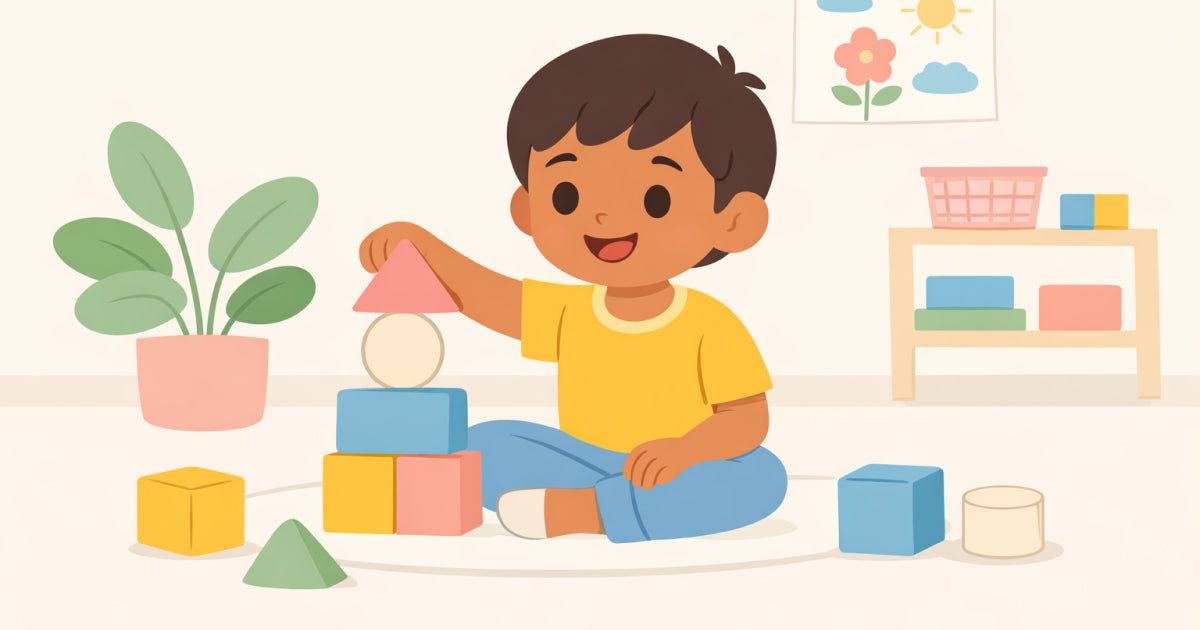
1. Pattern Building with Wooden Blocks (Ages 3-7)
Why It Works: Montessori activities for focus emphasize hands-on manipulation and spatial reasoning. Building complex patterns requires planning, visual discrimination, and sustained effort—all executive function skills that translate to better concentration.
How to Implement:
- Start with simple 2D patterns (arrange blocks by color/size)
- Progress to 3D structures (towers, bridges, houses)
- Challenge: "Can you recreate this design from memory?"
- Optimal session: 20-30 minutes
2. Sensory Discovery Bins (Ages 2-6)
Why It Works: Sensory play India experts recognize that tactile exploration calms the nervous system while encouraging focused investigation. When children scoop, pour, and sort materials, they enter a meditative state that builds attention span organically.
How to Implement:
- Fill a large container with rice, lentils, or sand
- Hide small objects (buttons, shells, toy animals)
- Provide tools: scoops, funnels, containers
- Let your child explore freely for 15-20 minutes
The Science: A 2024 study in the Indian Journal of Child Development found that 30 minutes of daily sensory play increased attention span by an average of 12 minutes over 6 weeks.
DIY Variation: Create themed bins (monsoon rice with blue food coloring + plastic fish, Holi-colored lentils + mixing cups).
3. Multi-Step Puzzles & Brain Games (Ages 4-10)
Why It Works: Best toys for concentration require problem-solving persistence. Unlike digital games with instant rewards, physical puzzles demand sustained trial-and-error—exactly what builds resilience and focus.
How to Implement:
- Start with age-appropriate piece counts (10-20 pieces for 4-year-olds)
- Work together initially, then encourage independent completion
- Introduce tangrams, pattern matching, and sequence puzzles
- Celebrate effort, not just completion
Research Insight: The American Academy of Pediatrics (AAP) recommends puzzles as one of the top three activities to increase focus in kids, citing improvements in visual-spatial skills and working memory.
4. Open-Ended Construction Play (Ages 3-12)

Why It Works: Deep play for children happens when there's no "right" answer. Open-ended construction materials (unlike prescriptive building sets) require sustained creative thinking and planning.
How to Implement:
- Provide loose parts: cardboard tubes, wooden planks, fabric scraps
- Pose challenges: "Can you build a bridge strong enough for this toy car?"
- Resist the urge to direct—let your child struggle productively
- Allow 30-45 minute uninterrupted sessions
5. Nature-Based Scavenger Hunts (Ages 3-10)
Why It Works: Attention span development activities work best when they engage multiple senses and natural curiosity. Outdoor scavenger hunts combine observation, memory, and physical movement—a powerful trifecta for focus.
How to Implement:
- Create visual lists (draw/photograph items to find)
- Start simple: "Find 3 different leaves, 2 smooth stones, 1 feather"
- Progress to sensory challenges: "Find something rough, soft, and spiky"
- Optimal duration: 20-40 minutes
Science-Backed Benefit: A 2025 study by the Center for Environment Education, Ahmedabad, found that children who participated in weekly nature activities showed 42% better sustained attention in classroom settings.
Budget-Friendly: This requires zero investment—just printable hunt cards and a local park or even your building compound.
6. Storytelling with Sequence Cards (Ages 3-8)
Why It Works: This activity to improve concentration in child development targets auditory processing and logical sequencing—skills directly tied to academic focus.
How to Implement:
- Use picture cards showing story sequences (morning routine, planting a seed)
- Mix cards and ask your child to arrange them in order
- Have them narrate the story aloud
- Create custom cards using family photos
Research Insight: NCERT's 2024 Early Childhood Education Guidelines emphasize narrative sequencing as foundational for attention control and comprehension.
7. Focused Art with Single Materials (Ages 2-10)
Why It Works: How to increase focus in kids? Limit choices. When children work with just one art medium (clay, watercolors, charcoal), they dive deeper rather than flitting between options.
How to Implement:
- Monday: Air-dry clay only
- Wednesday: Watercolors only
- Friday: Collage with magazine cutouts only
- Provide ample time (30-60 minutes) without interruption
The Montessori Connection: Maria Montessori advocated for "isolation of concept"—presenting one skill/material at a time to deepen concentration.
Age-Specific Implementation Guide
Ages 2-3: Building Attention Foundations
- Target duration: 5-10 minutes of focused play
- Best activities: Sensory bins, simple stacking, large-piece puzzles
- Parent role: Play alongside, minimal verbal interruptions
Ages 4-5: Expanding Attention Capacity
- Target duration: 15-20 minutes
- Best activities: Pattern building, story sequencing, nature hunts
- Parent role: Offer gentle challenges, celebrate persistence
Ages 6-8: Developing Self-Directed Focus
- Target duration: 25-40 minutes
- Best activities: Complex puzzles, construction projects, focused art
- Parent role: Step back, provide resources, check in periodically
Ages 9-12: Mastering Sustained Engagement
- Target duration: 45-60+ minutes
- Best activities: Multi-day building projects, detailed art, cooperative games
- Parent role: Facilitator only, encourage self-designed challenges
Creating a "Focused Play Environment" at Home
Even the best toys for concentration won't work in a chaotic environment. Here's how to set up for success:
The 5 Principles of Distraction-Free Play
- Dedicated Play Zone: A consistent, screen-free corner with organized materials
- Limited Toy Rotation: Display only 3-5 options at a time (reduces decision fatigue)
- Natural Lighting: Position play area near windows when possible
- Minimal Clutter: Use low shelves with clear containers—visual calm promotes mental calm
- Respect "Flow Time": Establish a no-interruption rule during focused play
Dr. Kavita Reddy, child psychologist at Max Hospital Delhi, advises: "Children need predictable, calm spaces to develop attention. A corner with 5 well-chosen, open-ended toys will always outperform a room full of flashy, battery-operated distractions."
Real Results: What Indian Parents Are Experiencing
Case Study: The Sharma Family, Hyderabad
Challenge: 6-year-old Ananya couldn't focus for more than 3 minutes, constantly asked for cartoons.
Intervention: Implemented 30-minute daily "Focused Play Hour" using Kugloo's wooden puzzles and construction sets for 8 weeks.
Results:
- Week 1-2: Average focus time 8 minutes
- Week 3-4: 15 minutes
- Week 5-6: 22 minutes
- Week 7-8: 35 minutes consistently
Parent Quote: "Her kindergarten teacher couldn't believe the transformation. Ananya now completes activities independently and rarely asks for screen time during the day."
FAQ: Improving Your Child's Attention Span
Q1: At what age should I start attention span training?
A: You can begin as early as 18 months with simple activities like stacking rings or sensory bins. The key is age-appropriate expectations—toddlers naturally have 5-7 minute attention spans, which gradually extend to 20-30 minutes by age 5-6.
Q2: How long does it take to see improvement in child concentration?
A: Most parents notice changes within 2-4 weeks of consistent, daily focused play (20-30 minutes). Sustained improvement requires 8-12 weeks of building the habit. Remember, you're creating new neural pathways—it takes time.
Q3: Can screen-free play really compete with tablets and TV?
A: Absolutely. The initial transition may involve resistance (screens provide intense dopamine hits), but within 1-2 weeks, most children rediscover the satisfaction of hands-on play. The secret is consistency and offering truly engaging alternatives.
Q4: What if my child has diagnosed ADHD? Will these activities help?
A: Yes, with modifications. Research from NIMHANS shows that structured sensory play and Montessori activities for focus significantly help ADHD children when combined with professional treatment. Consult your pediatrician for personalized strategies.
Q5: How do I handle screen time withdrawal tantrums?
A: Set clear boundaries ("Screens only after 5 PM") and offer compelling alternatives immediately. Keep wooden toys for concentration visible and accessible. Most tantrums diminish after 7-10 days of consistency.
Q6: Are expensive toys necessary for building focus?
A: No. While quality wooden toys benefits India include durability and safety, DIY options (cardboard blocks, nature treasures, rice bins) work equally well. The key is open-ended materials that require creative thinking.
The Kugloo Difference: Focused Play by Design
Every Kugloo product is intentionally designed around our "Built for Focused Play" ideology. Here's what sets us apart:
Our Design Philosophy
- No batteries, lights, or sounds – eliminates overstimulation
- Natural materials – wood and fabric provide sensory richness that sustains engagement
- Open-ended potential – one toy, infinite possibilities = deeper play
- Progressive challenge – designs that grow with your child's developing skills
Our Promise to Indian Parents
We understand the unique challenges you face—managing joint family opinions on screen time, finding quality toys amidst cheap plastic imports, and balancing modern parenting with traditional values. Our play systems honor your child's need for deep engagement while respecting your family's lifestyle.
Your 30-Day Focused Play Challenge
Ready to transform your child's attention span? Here's your actionable roadmap:
Week 1: Foundation
- Choose 2-3 activities from this article
- Create a dedicated play corner
- Establish a daily 20-minute "Focused Play Hour"
- Remove distractions (TV off, phones away)
Week 2: Building Momentum
- Increase play time to 25-30 minutes
- Rotate activities to maintain interest
- Track your child's longest focus duration
Week 3: Deepening Engagement
- Introduce more challenging variations
- Aim for 30-40 minutes of sustained play
- Notice improvements in other areas (mealtime, bedtime routine)
Week 4: Celebrating Progress
- Measure attention span gains (compare to Week 1)
- Share your journey with family members
- Explore new Kugloo activities to maintain growth
Conclusion: Building a Future of Focused Children
In a world designed to fragment attention, giving your child the gift of focus is one of the most powerful things you can do as a parent. The seven activities to improve concentration in child development we've shared aren't just about better behavior today—they're about building executive function skills that will serve your child for life.
Whether it's acing exams through sustained study sessions, developing expertise in sports or arts through deliberate practice, or simply experiencing the joy of "flow" in daily life, strong attention spans are the foundation of human excellence.
At Kugloo, we envision a generation of children with strong attention spans who can engage deeply with the world around them—without screens or constant stimulation. Every play system we create is a step toward that vision—one focused hour at a time.
Editor’s Recommendations
Start Your Focused Play Journey Today
Explore Kugloo's complete "Built for Focused Play" collection:
Shop All Focus-Building Toys Free shipping on orders above Rs.499
Join Our Parent Community: WhatsApp us at +91-9625965890 for personalized play recommendations based on your child's age and interests.


Recent Post


Tags


